
Article: How to Pick a Gentle Face Cleanser for Sensitive Skin
How to Pick a Gentle Face Cleanser for Sensitive Skin
If you need a gentle face cleanser for sensitive skin, you've likely already learned that the word "gentle" on a label means very little. You pick up a cleanser with "gentle" and "soothing" printed right on the front, use it for three days, and wake up with tight, red, irritated skin that's somehow worse than before. Terms like "gentle" are often loosely defined or inconsistently applied in cosmetic marketing, Health Canada and regulatory bodies in other markets don't require brands to meet a defined standard before using them, and for people with reactive skin, that gap between marketing and reality is costly, both financially and for your skin barrier.
Sensitive skin isn't a single condition. It can show up as eczema flares that crack and weep, rosacea flushing that never fully calms down, acne-prone skin that reacts to everything you try to fix it with, or plain dryness that tips into peeling the moment temperatures drop. Each of these needs a different approach to cleansing. By the end of this guide, you'll know exactly what makes a fragrance-free face wash for sensitive skin genuinely gentle, which ingredients to look for, and which to skip entirely. You'll also know how to match a formula to your specific sensitivity pattern. And if you're shopping in Canada, finding those products used to mean ordering blind from international brands with no way to try before committing. That's no longer the case.
Why most cleansers irritate sensitive skin in the first place
Your skin barrier is a lipid-rich protective layer that does two jobs simultaneously: it keeps moisture inside and keeps irritants out. When a cleanser disrupts that layer, both functions break down. Moisture escapes faster, irritants penetrate more easily, and skin becomes reactive, not because it's fragile by nature, but because its defenses have been compromised by repeated exposure to the wrong formula.
pH plays a bigger role here than most people realize. Healthy skin sits at a slightly acidic pH of around 4.5 to 5.5. Traditional bar soaps and high-foam cleansers are often more alkaline, commonly above pH 7, which disrupts the barrier and impairs the skin's natural enzyme activity. A cleanser formulated to stay within that acidic range causes far less disruption, which is why dermatologists consistently recommend pH-balanced formulas designed to stay in that 4.5 to 5.5 sweet spot, especially for eczema-prone skin.
Surfactant type matters just as much as pH. Sodium lauryl sulfate (SLS) is the most studied offender: it binds to and disrupts stratum corneum lipids and proteins, increases transepidermal water loss, and in sensitive skin, can penetrate the compromised barrier to trigger inflammation and itch. Contrast that with sodium cocoyl isethionate, a milder surfactant found in well-formulated cleansers like Cetaphil Gentle Skin Cleanser, which cleans without the same level of lipid disruption. Non-foaming and low-lather formulas tend to rely on milder surfactant systems, syndet bars and cream cleansers, for example, which is why they're generally the safer choice for reactive skin types.
Ingredients that actually calm and repair a gentle face cleanser for sensitive skin
When you flip a cleanser bottle and scan the ingredient list, a few names tell you quickly whether it was formulated with barrier health in mind. These aren't trendy additions; they're ingredients with clinical research behind them.
Barrier-repair lipids
Ceramides are the most important barrier-repair ingredient in any cleanser designed for sensitive skin. They are skin-identical lipids that actively replenish the structural layer damaged by harsh cleansing. A clinical study examining a formula combining ceramides with glycerin and hyaluronic acid found measurable improvement in skin barrier function and hydration over 24 hours. Glycerin is a proven humectant that draws water into the stratum corneum; it has been a standard in gentle formulations for decades because it improves moisture retention without causing irritation.
Humectants
Hyaluronic acid adds surface hydration and pairs well with ceramides, though it works on the outer layers rather than replacing the lipid barrier itself. Glycerin and hyaluronic acid together give a formula staying power between washes without adding any sensitizing risk.
Botanicals worth considering
Ectoin is worth knowing about even though it hasn't been in the spotlight as long as the others. It's a naturally occurring microbial molecule with clinical support for reducing irritation and improving hydration in sensitive skin. Some research suggests it may be beneficial in various stress conditions, including redness-prone skin, though more targeted studies are ongoing. Colloidal oatmeal has the strongest botanical evidence for eczema-prone skin: it's clinically recognized for reducing dryness, itching, and irritation while supporting barrier recovery. Calendula has a long history of calming inflamed skin and improving hydration after irritant exposure; it's well tolerated even on reactive skin, though its evidence base is smaller. Aloe vera is commonly reported to have soothing and humectant properties, though clinical evidence in cleanser formulations is more limited, if it appears high in the ingredient list rather than as a trace addition, it's worth considering.
Red-flag ingredients to skip in any face wash for sensitive skin
Natural doesn't automatically mean gentle, and "free from parabens" on the front label tells you nothing about whether the formula is actually safe for reactive skin. The ingredients below are the ones most likely to cause problems, regardless of how the product is marketed.
- Fragrance and parfum, the single most common triggers for contact irritation and allergy in sensitive skin. This applies to synthetic fragrance and to fragrance compounds derived from natural sources like linalool and limonene.
- SLS and SLES, strip skin lipids, elevate pH, and increase the skin's permeability to other irritants, compounding the damage.
- Drying alcohols, specifically denatured alcohol, ethanol, and SD alcohol, dehydrate the barrier at the concentrations typically used in cleansers. Note that fatty alcohols like cetearyl alcohol are chemically different and generally well tolerated.
- Dyes and colorants, serve no functional purpose in a cleanser and can be sensitizing for some people; consider avoiding them if your skin is reactive.
Essential oils deserve their own mention because this is where well-intentioned "natural" cleansers often go wrong. Lavender, peppermint, citrus oils, eucalyptus, and tea tree oil are all high in bioactive compounds. Those compounds are exactly what makes them aromatic and potent, and precisely what makes them potential irritants for reactive skin. They appear under their botanical INCI names on ingredient lists: Lavandula angustifolia for lavender, Mentha piperita for peppermint. Once you can spot them, you'll read labels much faster. A gentle face cleanser for sensitive skin that's free of both fragrance and essential oils is a meaningfully safer starting point for anyone whose skin reacts easily.
Matching your gentle cleanser to your specific sensitivity pattern
Sensitive skin is a category, not a skin type. The right formula for one person's eczema-prone cheeks is not the right formula for someone managing rosacea flushing or acne-prone reactivity. Narrowing down your specific pattern makes choosing far more straightforward.
For eczema and very reactive skin, the priority is a non-foaming, fragrance-free, hypoallergenic formula with ceramides and colloidal oatmeal. Cream and lotion cleansers are the safest format. Skip all active ingredients: no AHAs, BHAs, or retinoids anywhere near an eczema-prone cleanser. The goal at this stage is to clean without provoking; everything else waits until the barrier is stable.
Rosacea responds best to pH-balanced, low-friction formulas with anti-redness support from ingredients with clinical backing, such as ectoin. Green tea extract appears in some sensitive-skin formulas marketed for redness, though direct clinical evidence for rosacea specifically is more limited. Avoid fragrance, alcohol, abrasives, and anything that generates heat or tingling on the skin. Menthol and peppermint are especially problematic for rosacea despite being common in "refreshing" cleansers. One practical note: rinse with lukewarm water, never hot. Heat dilates blood vessels and can trigger or worsen flushing.
Acne-prone but sensitive skin presents a specific challenge because most acne cleansers are formulated to strip oil aggressively, which worsens barrier function and can actually increase breakouts. Look for a gentle cleanser for reactive skin that removes excess oil without over-drying. If you want a low concentration of niacinamide or salicylic acid to address congestion, confirm that the base formula is completely fragrance-free first. Over-cleansing is as much a problem as under-cleansing here: twice daily, maximum, with a gentle formula between washes if you feel you need it.
The risk-free way to find your perfect cleanser in Canada
Many sensitive-skin shoppers in Canada burn money buying a full-size cleanser based on a promising ingredient list, only to react within two uses. Many retailers don't accept opened skincare for return, which makes sample-first shopping particularly appealing for reactive skin types.
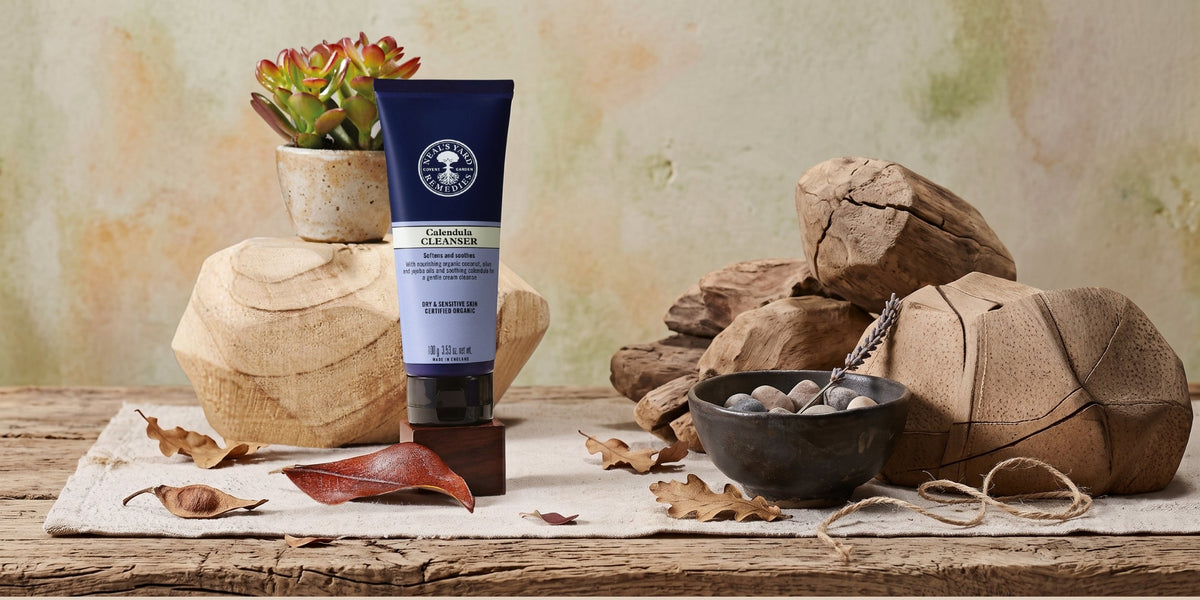
High Street Shoppe is a Canadian online retailer curating natural and organic skincare brands chosen for clean, thoughtfully formulated products. Brands like Evolve Organic Beauty and Neal's Yard Remedies, both carried at High Street Shoppe, build many of their cleansers around exactly the kinds of ingredients covered in this guide: ceramides, calendula, glycerin, and fragrance-free bases designed for sensitive and reactive skin.
Every order from High Street Shoppe includes three complimentary product samples. For sensitive-skin shoppers, this changes the risk calculation entirely. You sample the cleanser, do a proper use test, watch how your skin responds over several days, and then commit to a full size only if it works for you. Free shipping on orders over $99 CAD makes stocking up on a full routine practical once you've confirmed the right formulas. The site also includes a skin-type filtering tool that lets you sort by sensitive skin directly, so you're not sorting through products that aren't relevant to your concerns. It's a much smarter entry point than buying blind.
How to introduce a new gentle face cleanser without triggering a flare-up
Even the right cleanser, introduced too quickly or used with poor technique, can cause a short-term response that gets misread as an incompatibility. The right protocol removes most of that ambiguity.
For rinse-off products like cleansers, dermatologists typically recommend a use test rather than a short occlusive patch test. Apply the cleanser to a small, discreet area, the side of the neck or behind the ear works well, twice daily for seven to ten days. Look for redness, itching, swelling, or a burning sensation. A mild tingle on first application is different from sustained irritation: the tingle should settle within a minute or two, while true irritation tends to build or persist. If you see any of those reaction signs, stop and do not use the product on your face.
Once you move to full facial use, give the cleanser at least one to two weeks before drawing firm conclusions, keeping in mind that the seven to ten day use-test window is the standard benchmark. Signs the cleanser is working: skin feels comfortable within 10 to 15 minutes of rinsing, not tight, not oily, not reactive. Signs of barrier damage: persistent tightness, redness that lasts more than 30 minutes after rinsing, stinging during application, or increased breakouts. One more note: don't layer active ingredients (exfoliants, vitamin C, retinoids) while you're transitioning to a new cleanser. Barrier recovery takes time, and stacking actives on a skin barrier you're still evaluating makes it impossible to understand what's causing what.
Finding the right formula is worth the effort
The right gentle face cleanser for sensitive skin isn't the most expensive one or the one with the longest ingredient list. It's the one that cleans effectively while staying within your skin's pH range, avoiding the ingredients most likely to trigger a reaction, and delivering at least some barrier-supportive benefit alongside the cleansing action. That's a specific, achievable target once you know what you're looking for.
Run through the checklist: fragrance-free base, no SLS, no essential oils, with ceramides or glycerin or a soothing botanical like colloidal oatmeal or calendula. Match the formula format to your sensitivity pattern, eczema, rosacea, or acne-prone reactivity. Then test before you commit to a full size.
If you're shopping in Canada and want to skip the guesswork, the High Street Shoppe sensitive skin category is worth browsing. With three complimentary samples included in every order, you can test before you commit, no wasted bottles, no weeks of recovery from a formula that doesn't suit your skin. Just cleaner skin, chosen carefully.